Banking Legislation (Miscellaneous Amendments) Bill 2026 in Hong Kong: What changes lie ahead?
The Banking Legislation (Miscellaneous Amendments) Bill 2026 (the “Bill”) was gazetted on 5 June 2026 and completed the First Reading in the Legislative Council (LegCo) on 17 June 2026. The Bills Committee has held its first meeting on 10 July 2026 and the next meeting has not yet been scheduled.
The Bill mainly seeks to amend the Banking Ordinance, Cap. 155 (BO) while also using the opportunity to amend two statutes that are relevant to the banking sector, namely, the Financial Institutions (Resolution) Ordinance, Cap. 628 (FIRO) and The Hong Kong Association of Banks Ordinance, Cap. 364 (HKABO). The goal is to ensure that such banking legislation continues to be fit for purpose and conducive to future developments in the evolving landscape and business environment of the banking industry.
In this legal update, we will give a high-level overview of the amendments to help you identify action points for complying with the revised statutes.
Key takeaways
1. Topics covered by the Bill
The Bill introduces amendments which cover seven subject areas:
- The first five subject areas fall under the BO:
- confer express power on the Hong Kong Monetary Authority (HKMA) to directly supervise bank holding companies of authorized institutions (AIs) incorporated in, or re-domiciled to, Hong Kong
- confer express power on HKMA to engage skilled persons to facilitate HKMA’s performance of supervisory functions
- elaborate on HKMA’s enforcement and disciplinary powers
- simplify the three-tier banking system to two-tier by removing deposit-taking companies (DTCs)
- various technical amendments to enhance regulatory clarity and effectiveness
- The remaining two subject areas fall under the FIRO and the HKABO respectively:
- amend one of the conditions for initiating resolution pursuant to the FIRO to enable HKMA to take public interest into account in handling a crisis scenario
- amend the HKABO to enhance the operational efficiency of HKAB
2. Mostly codifying and enhancing HKMA’s existing practices and policies
Most of the substantive amendments introduced by the Bill are not brand-new points but rather formally codifying, elaborating or clarifying HKMA’s existing policies or practices. The codified or elaborated powers of HKMA mainly focus on prescribed circumstances or incidents. Therefore, the substantive amendments may not necessitate immediate remediate action for most AIs.
The amendments set out in Parts 7 and 8 of the Bill are broadly classified as technical amendments. That said, some of the amendments set out in Part 7 have practical implications. The amendments set out in Part 8 relate to nomenclatures to align and update terminology across the BO and various subsidiary legislations.
3. Commencement dates and timeline
According to the Bill, the Banking Legislation (Miscellaneous Amendments) Ordinance will come into operation on 1 January 2027 except that:
- Part 4 (amendments on HKMA’s enforcement powers) will come into operation on 1 January 2028
- Part 5 and Part 6 (simplification of the three-tier banking system and related amendments, except certain provisions in Part 5) will come into operation on 1 January 2032
- Sections 218, 220 and 225 (certain amendments relating to the Banking (Liquidity) Rules, Cap. 155Q) will come into operation on 1 July 2027
- Part 9 (amendments relating to HKAB) – the amendments relating to the constitution of HKAB’s Consultative Council will come into operation on 1 January 2027, to enable prior arrangements to be made ahead of the HKAB’s annual general meeting in 2027, and the remaining amendments will come into operation on the date of the 2027 annual general meeting
More details about the amendments
4. Bank holding companies
It has long been HKMA’s policy that a person intending to hold more than 50% of the share capital of an HK-incorporated AI should be a well-established bank or other supervised financial institution in good standing in the financial community and with appropriate experience. Where an applicant does not fulfill this requirement, HKMA will generally impose conditions on that applicant and require the establishment of a holding company incorporated in Hong Kong, which will also be subject to conditions imposed by HKMA. The relevant policy and practice are set out in paragraphs 3.54 and 4.36 of HKMA’s Guide to Authorization.
Part 2 of the Bill sets out amendments relating to bank holding companies which formally codify HKMA’s policy and enhance regulatory clarity and effectiveness. Major amendments include:
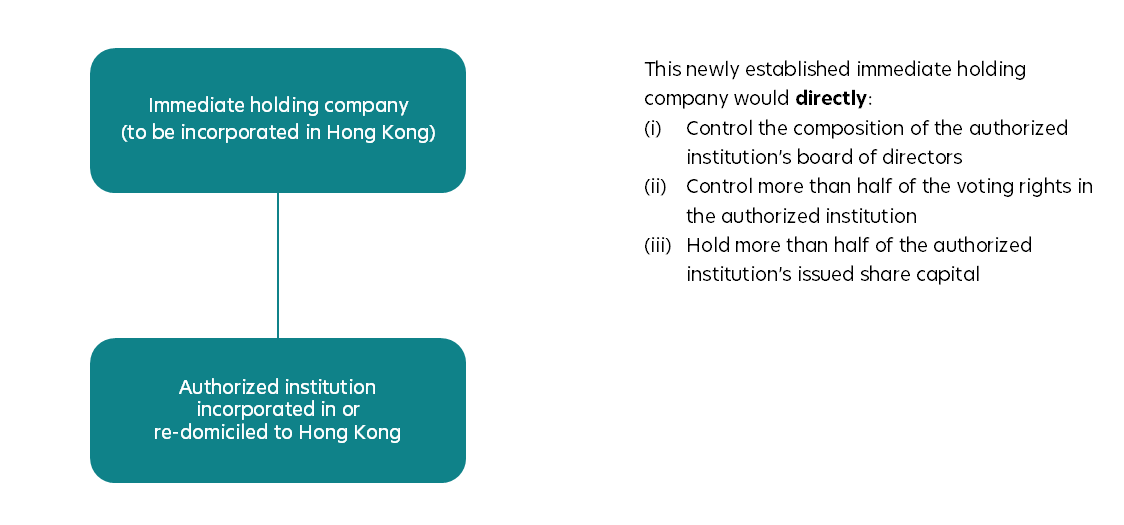
- Requirement to establish local immediate holding company. To add a new section 70E in Part XIII (Ownership and Management of Authorized Institutions) of the BO. This new section empowers HKMA to require a controller of an AI incorporated in, or re-domiciled to, Hong Kong to hold its interest in that AI through a “newly established immediate holding company” (defined in the Bill to mean an “immediate holding company” to be incorporated in Hong Kong). HKMA may impose this requirement regardless of whether there is already an immediate holding company in respect of the AI.
- Designation as DBHC. To add a new Part XIIIA (Bank Holding Companies) to the BO. This new Part empowers HKMA to designate a holding company (which is incorporated in, or re-domiciled to, Hong Kong) of an AI incorporated in, or re-domiciled to, Hong Kong as a designated bank holding company (DBHC). Part XIIIA further empowers HKMA:
- to impose requirements on the DBHC, including:
- requirements on aggregate amount of share capital and balance of share premium account, and capital and liquidity
- limitations on exposures, and restrictions on creation of charges
- restrictions on business or activities other than as bank holding company
- examination of books, accounts, transactions and systems of control by HKMA
- to extend the requirements and powers applicable to AIs to the DBHC, including:
- obtaining HKMA’s prior written consent for appointing chief executive or director
- publication of audited annual accounts
- submission of annual returns to HKMA
- requirements relating to audit, alteration of constitution, skilled persons, etc.
- submission of information to HKMA including information on the DBHC’s or its directors’ or other management personnel’ shareholding or other involvement in other companies, etc.
- intervention powers in view of the DBHK’s insolvency or inability or failure to meet obligations, etc.
- to impose requirements on the DBHC, including:
| AIs and their controllers which are caught by HKMA’s policy at present would have already established a HK-incorporated holding company and complied with the related conditions imposed by HKMA. Although no immediate remediate action or preparatory work may be required, the amendments and the elaborated or clarified powers (including the extent and how HKMA may exercise such powers) are relevant to all HK-incorporated or HK-redomiciled AIs and their controllers. |
5. Engaging skilled persons for supervisory purposes
Part 3 of the Bill sets out amendments relating to skilled persons and auditors. In addition to changing the heading of Part XI of the BO from “Part XI (Audits and Meetings)” to “Part XI (Audits and Appointment of Skilled Persons)”, other major amendments include:
- Appointment of skilled persons. To add new sections 61A and 61B in Part XI of the BO. These new sections empower HKMA to engage skilled persons to assist HKMA in exercising its functions under the BO, including preparing and submitting reports to HKMA on any matters relating to any AI that HKMA reasonably requires. Section 61A empowers HKMA to appoint the skilled persons whereas section 61B empowers HKMA to require an AI to appoint the skilled persons who must either be nominated by HKMA or nominated by the AI and approved by HKMA. The amendments do not set any qualification or other criteria for the skilled persons. This gives HKMA flexibility to appoint or approve such persons who possess the skills, knowledge, expertise and experience that are necessary for HKMA having regard to the facts and circumstances, and the complexity and technicality of matters to be addressed in each case.
- Amendments relating to auditors. To add new section 59AA in Part XI of the BO. This new section empowers HKMA to appoint auditors to prepare and submit reports to HKMA on any matters relating to any AI that HKMA reasonably requires.
- Reasonable assistance to skilled persons and auditors. To add new section 61C in Part XI of the BO. This new section requires an AI to give a skilled person or an auditor any assistance the skilled person or auditor may reasonably require to carry out the terms of the skilled person’s or auditor’s appointment.
- Extending requirements to approved money brokers. To add new section 61H in Part XI of the BO. This new section extends the requirements relating to skilled persons and auditors, including sections 61A, 61B and 61C to approved money brokers (AMBs).
- HKMA’s right to examine and investigate systems of control. To revise section 50 in Part IX (Overseas Branches, Overseas Representative Offices, Fees and Overseas Banking Corporations), and sections 55 and 56 in Part X (Powers of Control Over Authorized Institutions) of the BO. The revised sections expressly spell out HKMA’s right to examine and investigate an AI’s systems of control, in addition to its books, transactions and records, etc. This is not a new right. At present, HKMA has broad powers to require an AI to ensure the adequacy of systems of control over various activities or aspects of the AI’s business and operation. For example, one of the minimum criteria for authorization is that HKMA is satisfied that an AI has and will continue to have adequate accounting systems and adequate systems of control (see paragraph 10 of Seventh Schedule to the BO, and paragraph 4.85 of the Guide to Authorization).
| These amendments are unlikely to necessitate immediate remediate action or preparatory work. That said, all AIs ought to be aware of them and the potential exercise of the relevant powers and rights by HKMA in supervising the AIs. |
6. Amendments on enforcement powers
Part 4 of the Bill sets out amendments relating to HKMA’s enforcement powers. The major enforcement tool under the current BO is suspension or revocation of an AI’s authorization. The amendments refine the enforcement powers and confer “intermediate” disciplinary powers including reprimand and monetary penalty. These amendments bring the BO enforcement and disciplinary regime in line with that under the Securities and Futures Ordinance, Cap. 571 (SFO) and other statutory regimes such as the Insurance Ordinance, Cap. 41 and the Mandatory Provident Fund Schemes Ordinance, Cap. 485. The major amendments include:
- Confer comprehensive investigation powers and broaden the range of disciplinary actions. To add new “Part XXB Investigation and Disciplinary Powers” to the BO. To give a high-level idea, the structure and the substance of this new Part XXB bear resemblance to “Part VIII Supervision and Investigation” of the SFO. Notable points include:
- investigation and related powers (see Division 2 – Investigation, Part XXB) include:
- power to investigate defalcation, fraud, misfeasance and other misconduct
- power to require production of information, records and documents
- offences for failure to provide information, etc. or for providing false or misleading information, etc.
- applying for search warrants from magistrate
- disciplinary powers (see Division 3 – Disciplinary Powers, Part XXB) include:
- public or private reprimand
- pecuniary penalty up to the greater of HK$10 million or three times the amount of profit gained or loss avoided
- prohibition from acting or continuing to act as chief executive or director of AI or DBHC or AMB
- having exercised the disciplinary powers, HKMA may disclose to the public the details of its decision, the reasons for making the decision and material facts relating to the case
- HKMA will publish guidelines to indicate how it proposes to exercise the power to impose pecuniary penalties
- HKMA also has power to resolve disciplinary proceedings by agreement with the person subject to the disciplinary action where it is in public interest (see Division 4 – Miscellaneous Provisions, Part XXB)
- investigation and related powers (see Division 2 – Investigation, Part XXB) include:
- Clarify HKMA’s powers to discipline former relevant individuals or former executive officers. To revise section 58A (under Part X Powers of Control Over Authorized Institutions), to revise section 71C and add new section 72AB (under Part XIII Ownership and Management of Authorized Institutions) of the BO to expressly extend HKMA’s enforcement powers to any person’s non-compliance or misconduct during the period when that person was a relevant individual or an executive officer of an AI that is a registered institution under the SFO. New section 72AB empowers HKMA to require any person caught by section 58A or 71C to submit information to assist HKMA’s supervisory functions and prescribes the related offences of failure to provide information or providing false information.These amendments put beyond doubt HKMA’s powers to discipline regulated individuals of an AI apply; not only serving executive officers and serving relevant individuals, but also to former executive officers and former relevant individuals. The goal is to allow HKMA to continue its investigation and disciplinary case against those individuals even if they ceased to engage in securities-related activities for the AI before the completion of the investigation and disciplinary actions. This minimises unnecessary administrative work, for example, arising from the current need to transfer the uncompleted cases to the Securities and Futures Commission.
- Application to Banking Review Tribunal for review. To revise section 101B (under Part XVIIA Banking Review Tribunal) of the BO to enable an AI to apply to the Banking Review Tribunal for review of a disciplinary decision of HKMA pursuant to section 118U(2) or 118U(4).
| These amendments are unlikely to necessitate immediate remediate action or preparatory work. That said, all AIs ought to be aware of them and the potential exercise of the relevant powers and rights by HKMA in supervising AIs. |
7. Simplification of three-tier banking system
Parts 5 and 6 of the Bill set out amendments to simplify the existing three-tier banking system to a 2-tier system. The current three-tier banking system comprises licensed banks (LBs), restricted licence banks (RLBs) and deposit-taking companies (DTCs). According to the LegCo Brief on the Bill, the number of DTCs has dwindled over the years, accounting for only 0.08% of the total assets and 0.03% of the total customer deposits of the banking sector, with no DTC licence application since 2009.
HKMA issued a consultation paper on 26 June 2023 on its proposal to simplify the current three-tier banking system into a 2-tier system by merging DTCs into the RLB sector. HKMA published the consultation conclusions on 5 August 2024. According to the consultation conclusions, there will be a five-year transition period for existing DTCs to convert to a RLB by satisfying HKMA that they have met the minimum capital requirement of an RLB (i.e. HK$100 million). A DTC that wishes to upgrade to a RLB will not be required to submit fresh RLB licence application to HKMA. Alternatively, a DTC may decide to cease its DTC business before the end of the five-year transition period.
The amendments proposed in Parts 5 and 6 of the Bill implement the simplification and transition arrangements, including the five-year transition period.
- Part 5 of the Bill. The major amendments include:
- amendments to various sections of the BO to reflect the removal of the DTC tier
- amendments relating to the transition arrangements: to add a new “Part IVA Arrangement for Transition of Deposit-taking Companies to Restricted Licence Banks” to the BO:
- to enable a DTC to give written notice to HKMA of its intent to transition to a RLB which will initiate a streamlined authorization process without the need to submit a fresh RLB licence application
- to prescribe how a DTC shall handle the deposits lawfully taken before the transition (i.e. deposits that meet the HK$100,000 minimum amount for DTCs but fall short of the HK$500,000 minimum amount for RLBs) until the end of the five-year transition period
- to provide for the revocation of a DTC’s authorization if it has not transitioned to a RLB to HKMA’s satisfaction at the end of the five-year transition period
- Part 6 of the Bill. Part 6 of the Bill sets out amendments to other legislation containing references to DTC. Such other legislation includes Banking (Capital) Rules, Cap. 155L, Banking (Disclosure) Rules, Cap. 155M, Banking (Liquidity) Rules, Cap. 155Q, Securities and Futures (Financial Resources) Rules, Cap. 571N, Companies Ordinance, Cap. 622, FIRO, Inland Revenue Ordinance, Cap. 112, Prevention of Bribery Ordinance, Cap. 201, etc.
| The existing DTCs should review these amendments especially the transition arrangements, and act on a timely basis either to upgrade to RLBs or to cease DTC business before the end of the five-year transition period. |
8. Technical amendments
Parts 7 and 8 of the Bill set out various technical amendments to the BO. While broadly classified as technical amendments, the amendments set out in Part 7 have practical implications whereas the amendments set out in Part 8 relate to nomenclatures.
Notable amendments set out in Part 7 include:
| Part 7 amendments | Brief descriptions |
| Definitions of “currency” and “deposit” | Fall-back wording is added to these definitions to give HKMA flexibility to declare what is and what is not “currency” or “deposit” for the purposes of the BO. This allows HKMA to adjust the regulatory net in a timely manner as HKMA considers necessary and appropriate in response to the development of financial products and the fintech evolution.
Similar fall-back wording is already in use in relation to other regulatory regimes, including the definition of “stablecoin” in the Stablecoins Ordinance, Cap. 656, the definition of “virtual assets” in the Anti-Money Laundering and Counter-Terrorist Financing Ordinance, Cap. 615, and various definitions in the SFO such as “securities”, “structured product”, “OTC derivative product” and “professional investor”. |
| Definition of “indirect controller” | Compared to the existing definition, the expanded definition catches, in relation to a company, a person, whether acting alone or together with any other person, in accordance with whose directions or instructions, whether formal or informal, or wishes, the directors of the company, or of another company of which it is a subsidiary, are accustomed or under any obligation to act; or who is otherwise in a position or has the right to exercise, or actually exercises, significant influence or control over the company.
Compared to the definition of “indirect controller” in the SFO, the colour-shaded wording is also absent from the SFO definition. In particular, the words “informal”, “wishes” and “influence” could significantly lower the threshold for “indirect controller”. It remains to be seen how those words will be interpreted in practice in Hong Kong. The significance of the definition of “indirect controller” is mainly that HKMA’s written consent is required for any person to become and continue as an indirect controller of an AI and HKMA’s supervisory powers cover indirect controllers of AIs. |
| Section 69 (under Part XIII Ownership and Management of Authorized Institutions) | The revised section 69 extends the prior approval or notification requirements of HKMA to the disposal by a HK-incorporated AI of (i) all or any part of the business of taking deposits conducted by a non-local branch, or (ii) all or any part of its undertaking or interest in a non-local banking corporation. |
| Section 60 (under Part XI Audits and Meetings”, to be amended to Part XI Audits and Appointment of Skilled Persons) | The revised section 60:
|
| Sections 67 and 68 (under Part XII Disclosure of Information by Authorized Institutions) | The existing section 67 requires an AI to forthwith report to HKMA of all relevant facts, circumstances and information relating to its inability to meet obligations. The revised section 67 extends the reporting requirement to the occurrence or likely occurrence of any “material adverse development” in relation to the AI. The expression “material adverse development” refers to, without limitation, any development that has or is likely to have an adverse effect on the AI’s financial soundness or viability, ability to continue to carry on its banking business, or the AI is likely to become unable to meet its obligations or is about to suspend payment.
The revised section 68 allows a relevant non-HK supervisory authority, with HKMA’s approval, to examine the books, accounts transactions and systems of control of an AI’s non-banking activities for which such non-HK authority has supervisory responsibility. |
Notable amendments set out in Part 8 include:
| Part 8 amendments | Brief descriptions |
| Revising terminology | Aligning and updating the terminology across the BO and various subsidiary legislations. Changes include:
Replacing references to “working day” with “day” in the Banking (Liquidity) Rules, Cap. 155Q, for calculating average liquidity maintenance ratio and average core funding ratio based on calendar day, to reflect payments can now be made seven days a week and Hong Kong stock market trading continues despite typhoons or other severe weather conditions. |
| Of the various technical amendments set out in Parts 7 and 8 of the Bill, AIs may want to assess in particular the practical implications arising from the revised definition of “indirect controller” to see whether any remediate action is necessary. |
9. Amendments relating to The Hong Kong Association of Banks (HKAB)
- Part 9 sets out amendments relating to composition of HKAB’s Consultative Council and other operational or procedural requirements. The goal is to enhance operational efficiency of HKAB.
- Amendments to the HKABO and The Hong Kong Association of Banks By-laws include:
- amending section 9 and Schedule 1 of the HKABO regarding the constitution of HKAB’s Consultative Council to do away with the need to update Schedule 1 whenever a member from a new jurisdiction joins HKAB
- amending or adding the relevant provisions to enable meetings to be held by virtual meeting technologies other than in-person, or by deploying both modes, and the related notice and procedural requirements
10. Amendments relating to the FIRO
The FIRO implements a cross-sectoral resolution regime in Hong Kong in compliance with international standards. Part 10 of the Bill sets out amendment to section 25(4) of the FIRO to add an express reference to “public interest” in one of the conditions for initiating resolution of a financial institution. According to the LegCo Brief:
- The goal is to enable the relevant resolution authority to have regard to public interest in deciding whether to resolve a failing institution in a crisis situation.
- The amended condition better aligns with the equivalent provision in other major jurisdictions, such as Singapore, the UK, and the European Union, where experience drawn from financial turmoil in recent years indicates that there could be a need to initiate resolution for smaller banks in consideration of public interest as opposed to their failure posing risks to the stability and effective working of the financial system.
| These amendments set out in Parts 9 and 10 of the Bill are unlikely to necessitate immediate remediate action or preparatory work. |
Reference materials