
China sharpens antitrust focus: Algorithmic pricing and buyer-side power in the spotlight
Algorithmic pricing has become a focal point of antitrust enforcement worldwide. The 货拉拉 (Huolala) rectification marks Beijing’s first major public move to bring algorithmic pricing within the scope of antitrust enforcement. More importantly, however, it signals a broader shift in China’s antitrust regulator approach: using the Anti-Monopoly Law not only to scrutinise algorithms, but also to flag its growing focus on platforms’ exercise of buyer-side market power.
On 18 June 2026, China’s State Administration for Market Regulation (SAMR) announced a sweeping antitrust rectification of Huolala, the country’s largest intra-city freight-matching platform, concluding a nine-month supervisory process that began with a regulatory interview in September 2025.11
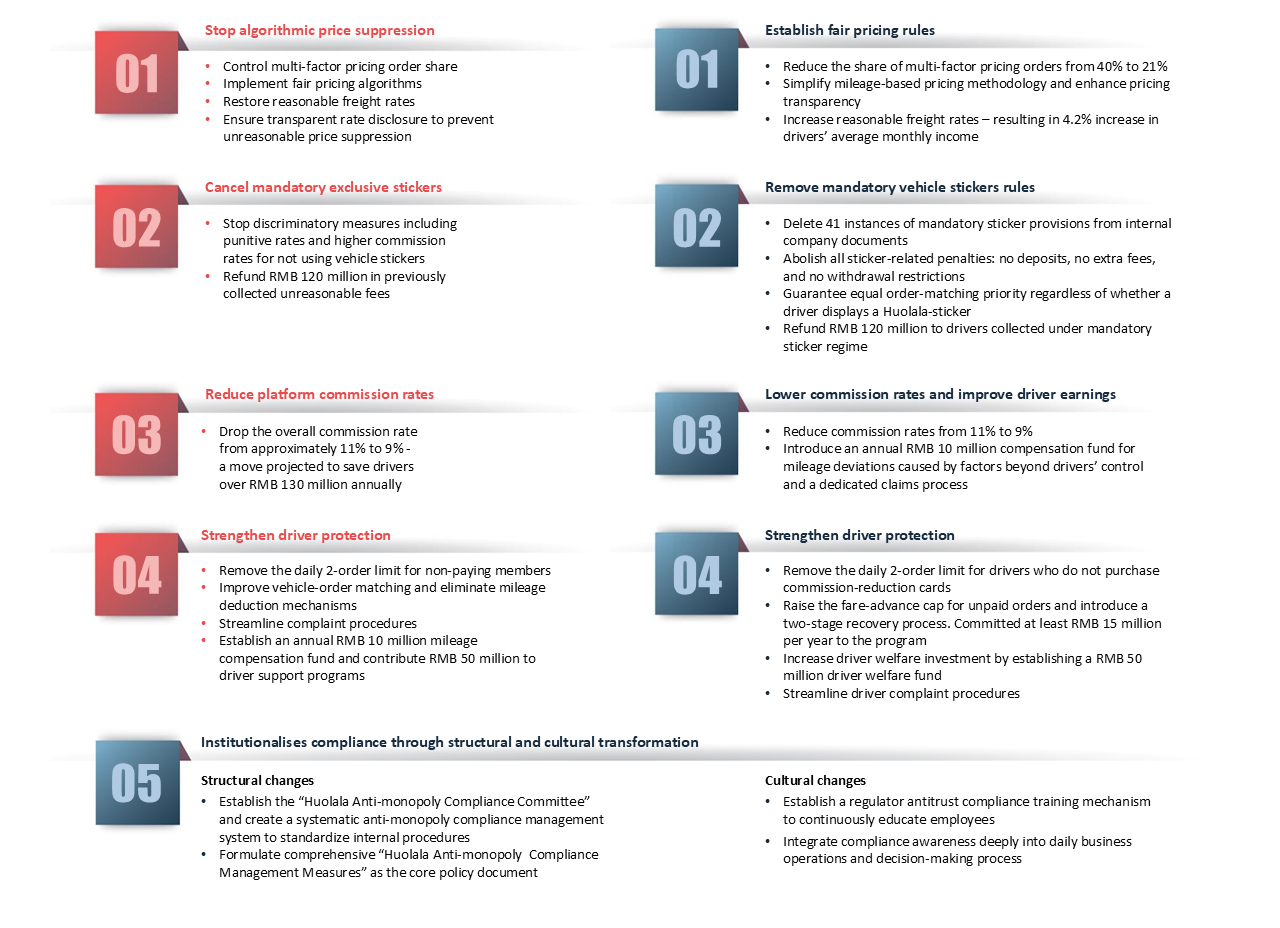
The rectification extends well beyond algorithmic pricing, requiring Huolala to overhaul its pricing algorithms, dismantle platform rules with exclusionary effects, reduce commission rates, strengthen protections for drivers, and establish a more robust antitrust compliance framework.
Huolala responded to SAMR’s requirements on the same day with a commitment to comply.22
SAMR’s rectification measures (red) and Huolala’s corresponding responses (blue)
What insight can be drawn from SAMR’s Huolala case?
Takeaway 1: Algorithmic pricing carries a genuine antitrust risk
Although algorithmic pricing remains a relatively new area of enforcement, regulators have made clear it is not exempt from antitrust scrutiny. The OECD’s recent report on algorithmic pricing and competition, surveying work across G7 antitrust authorities, signals that this concern is converging globally rather than confined to any single jurisdiction.33 The report organises these concerns around two theories of harm: collusion and unilateral conduct.
On collusion, the underlying worry is that algorithms can produce co-ordinated pricing outcomes through channels well beyond a traditional cartel agreement. These can take varying forms: algorithms may simply be used to execute or monitor a conventional price-fixing arrangement; they may create hub-and-spoke dynamics or vertical restraints; or they may give rise to tacit co-ordination through autonomous learning.
On unilateral conduct, a dominant firm’s use of pricing algorithms can itself amount to an abuse of market power. Pre-calibrated, non-transparent pricing mechanisms may enable predatory pricing, rebate structures or price discrimination designed to lock in users, deter switching and ultimately harm consumers.
The Huolala case shows this second theory playing out in practice – SAMR’s objection was that Huolala used its substantial market position to run an opaque, multi-factor pricing algorithm that suppressed rates paid to drivers. The remedy followed the theory: disclosure of pricing rules, a reduced share of multi-factor pricing and a return to transparent per-order and per-kilometre rates.
It is a concrete illustration that China, like European and other regulators pursuing unilateral-conduct theories, now treats an opaque pricing algorithm as sufficient grounds for antitrust enforcement.
Businesses should note that using AI or algorithmic pricing tools does not reduce their responsibility under competition law.
Companies are expected to understand how their pricing systems work – including the data inputs, the logic driving pricing outcomes and whether similar tools are used by competitors. This is particularly important where AI capabilities are added incrementally to existing pricing systems without a reassessment of antitrust risks.
In short, algorithms used for pricing, personalisation, market co-ordination or influencing consumer choice remain fully subject to existing competition laws, regardless of whether they are rule-based or self-learning.
Takeaway 2: SAMR’s focus signals growing scrutiny of platforms’ buyer-side market power
The Huolala case sits within a broader campaign. In 2026, SAMR has intensified its “反内卷” (anti-involution) push across the platform economy, targeting the low-price, race-to-the-bottom dynamics that algorithmic pricing can generate for those on the supply side.
What makes Huolala notable is who the rectification protects–not consumers but drivers, the supply side captured by the platform.
Viewed alongside SAMR’s parallel actions this year against food-delivery and travel platforms, the case points to a clear enforcement priority: reining-in large platforms’ buyer-side power over the merchants and workers who depend on them, not just their conduct toward end users.
This mirrors a broader global shift toward treating buyer-side market power as a genuine antitrust concern.
US antitrust authorities have increasingly incorporated labour market considerations into enforcement. The Department of Justice successfully challenged the proposed merger between Penguin Random House and Simon & Schuster, arguing that it would substantially lessen competition in the market for acquiring publishing rights from authors and reduce authors’ compensation.44 Also, the 2023 DOJ/FTC Merger Guidelines expressly recognise that mergers may harm competition in labour markets.55
In the EU, the European Commission’s (EC) new draft Merger Guidelines issued this May identify that reduced labour-market competition may constitute a theory of harm,66 and its recent Delivery Hero/Glovo decision demonstrates an increasing willingness to enforce against labour-market collusion,77 a priority increasingly echoed by national competition authorities such as those in Portugal, Italy and France.
In Hong Kong, the Competition Commission (HKCC) reached a resolution with Keeta in late 2025 after finding that contractual restrictions preventing restaurants from joining or promoting themselves on competing platforms risked locking in merchants and preventing multi-homing.
The common thread across jurisdictions is that a platform’s market power does not need to harm consumers directly to attract scrutiny–exploiting its supply-side is now independently actionable.
For business, the practical implication is to assess market power symmetrically: antitrust risk reviews should cover not only pricing and terms offered to end users, but also the leverage exercised over the counterparties–drivers, merchants and riders–who depend on the platform for their livelihood, as this becomes an active enforcement priority both in mainland China and among regulators worldwide.
Conclusion
The Huolala case is best read not as an isolated platform-economy fine, but as a signal on two fronts converging worldwide: algorithmic pricing is now squarely within antitrust regulators’ reach, and buyer-side market power (monopsony) is increasingly as actionable as harm to consumers.
Businesses should take this opportunity to review both areas proactively, rather than waiting until a similar regulatory intervention reaches their own doorstep.
- SAMR, SAMR Monitors Huolala’s Implementation of Antitrust Rectification, Jun. 2026, at: https://www.samr.gov.cn/xw/zj/art/2026/art_6b95ab4f659a4c5888a36cdadd856aad.html; SAMR, SAMR had a regulatory meeting with Huolala, Sep. 2025, at: https://www.samr.gov.cn/xw/zj/art/2025/art_dc1090ffa0d143699aad412d25c7654a.html
- Pengpai News, Huolala published announcement to implement SAMR’s requirments, Jun. 2026, at:
https://www.thepaper.cn/newsDetail_forward_33408459 - OECD, Algorithmic pricing and competition in G7 jurisdictions, 3 October 2025, at: https://www.oecd.org/en/publications/algorithmic-pricing-and-competition-in-g7-jurisdictions_f36dacf8-en.html
- US Department of Justice (DOJ), Justice Department Obtains Permanent Injunction Blocking Penguin Random House’s Proposed Acquisition of Simon & Schuster, Oct. 2022, at: https://www.justice.gov/archives/opa/pr/justice-department-obtains-permanent-injunction-blocking-penguin-random-house-s-proposed
- US DOJ and Federal Trade Commission, 2023 Merger Guidelines, Dec. 2023, at: https://www.ftc.gov/system/files/ftc_gov/pdf/2023_merger_guidelines_final_12.18.2023.pdf
- EC, Draft Merger Guidelines (for public consultation), May 2026, at: https://competition-policy.ec.europa.eu/mergers/review-merger-guidelines_en
- EC, Commission fines Delivery Hero and Glovo €329 million for participation in online food delivery cartel, Jul. 2025, https://ec.europa.eu/commission/presscorner/detail/hr/ip_25_1356


